
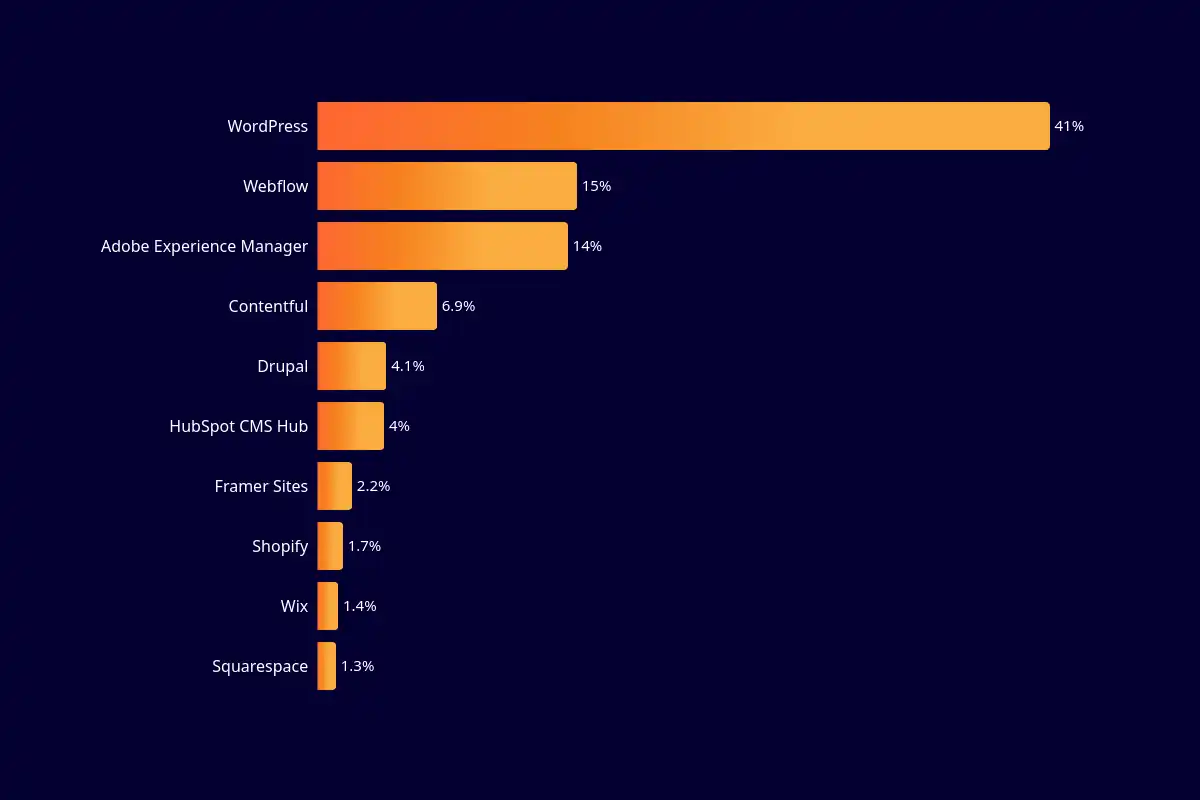
You may have heard it been said that WordPress powers 40% of websites on the internet. I have seen this mantra repeated in web development forums for years now. At first I was cynical, as I am of a lot of statistics. But I recall seeing a survey of website technologies about 5 years ago and WordPress was indeed placed as the number one CMS with usage estimated at 40%.
This apparently hasn’t changed; Cloudflare’s 2025 year in review of website technologies shows WordPress is still estimated to power around 40% of sites. What has changed in that time has been my personal adoption of WordPress. There are good reasons for WordPress’ dominance in the crowded web technology business, which is why we have adopted it more and more, here are three.
A vast ecosystem of plugins
In my opinion this is the single most beneficial perk of the WordPress universe. WordPress encourages extending it’s functionality by third-party developers through its plugin system. As a result an extensive market of plugins that provide practically any functionality you want to add to your website exists. Whatever you need, a booking system, a google calendar integration, a social media widget… it probably exists and is available with a few clicks to download from the WordPress repository.
Building software takes time, and this diverse repository of plugins enables features to be integrated into sites at great speed. The features these plugins offer can then be developed and maintained by the plugin owners and the end user benefits from this development. Of course this exists on other platforms too, but WordPress’ popularity means it attracts thousands of developers to this space and the size of the repository reflects this.
There is a downside, not all plugins are created equal. There are vast differences in quality of the available plugins and a poorly coded one can break your site. The WordPress team vets new plugins, but despite this, the barrier to listing in the repository is relatively low and poorly coded plugins get into the system. That’s why it is important to audit plugins before you install them, especially on a live site. How to effectively audit plugins is beyond the scope of this article, but at the bare minimum checking the reviews and current issues, which are publicly available in the repository, is a must.
Free and open source
WordPress is free and open source software. If you are not familiar with this concept it means you can download a copy of WordPress from WordPress.org, then this copy is yours to do what you want with. You can install your copy of WordPress on any computer or server you want. You own your website. If you don’t like your current host, you can simply export your site, find a new host and upload your WordPress site to the new host and carry on.
This isn’t true for website providers that offer their software as a service such as Wix, Squarespace and Shopify. When you build a website on their platform, it has to stay on their platform. If you decide you want to change platforms, you have to rebuild your site elsewhere, which takes time and money. It also means you are locked in to the platform’s pricing plans. While their pricing will be somewhat affected by market forces and there does exist a lot of competition in this space, it doesn’t compare to the number of providers that are available for hosting WordPress sites.
A mature technology
It sometimes feels like every month there is a new web framework for developing sites that touts their benefits over older systems. But there are significant benefits to older technologies. Technologies that stand the test of time have the chance to develop plentiful resources for how to learn them. WordPress itself has been around for over 20 years and is built on similarly mature programming languages. If you want to learn any particular aspect of WordPress there are abundant videos, books and courses to do so.
There is also an extensive market of developers to hire in building WordPress sites. I have seen first hand start-ups adopt some of the latest technologies then later on are unable to find the necessary developers able to work on their systems. They are consequently left with difficult and expensive choices about how to maintain or rebuild their systems. These shiny new systems often claim to be the greatest technology the web development industry has ever seen, and they might be, but until they stand the test of time, they also carry inherent risks associated with adopting early technologies.
The end?
So we should all use WordPress then! Not always, its a tool for a job, but it happens to be a very general purpose tool fit for many jobs. For the large majority of website owners, however, it is a good choice. It isn’t perfect and has its fair share of issues, but the benefits, especially the ones listed above, outweigh the negatives and outweigh a lot of the competition.
If you are in need of a website and not sure how to build it, get in touch and we will be happy to help. While we do build a lot of sites with WordPress we will choose the right technology for your site.